Bronze Age · c. 3000 BC · Wadi Khamila, South Sinai, Egypt
5,000-year-old rock carving in Egypt's Sinai shows Egyptians subduing a local man
Found in Wadi Khamila by an Egyptian antiquities inspector, the scene carries an inscription naming the god Min as ruler of the copper region, a Bonn Egyptologist says.
Peer-reviewed paper
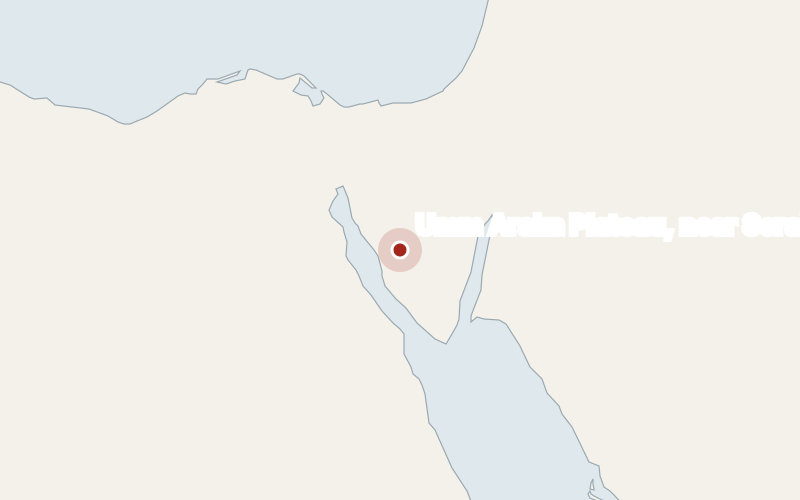
Wadi Khamila, Egypt A rock carving around 5,000 years old shows a large man with raised arms facing a smaller kneeling figure. The kneeling figure has an arrow in his chest. The carving is in Wadi Khamila, in the south-west of Egypt's Sinai Peninsula.
Ludwig Morenz, an Egyptologist at the University of Bonn, reads the scene and its short inscription as an Egyptian claim to the region. He dates the claim to the late fourth millennium BC. At that time, expeditions from the Nile Valley were coming to Sinai for copper and turquoise.
Mustafa Nour El-Din found the carving during exploratory trips in the area. He is an inspector at the Aswan Inspectorate of the Egyptian Ministry of Antiquities. Morenz published his interpretation in the journal Blätter Abrahams.
E. Kiesel has made a redrawing of the panel. In it, the kneeling man has his arms bound behind his back. Behind him is an Egyptian boat. The researchers read the boat as a sign of Egyptian presence and dominance.
The inscription above the scene reads "God Min, ruler of the copper region". Morenz says the figure with raised arms stands in a victor's pose. He identifies the victor as an Egyptian and the wounded man as a local inhabitant.
The motif that has now been discovered is one of the oldest known scenes of killing with an accompanying inscription.
Ludwig Morenz, Egyptologist, University of Bonn
Three sites and the god Min
Morenz describes the people of Sinai at the time as having no writing and no state organisation. Egyptians also left images of domination in two other wadis, Wadi Ameyra and Wadi Maghara. Wadis are the dry valleys that cut through the peninsula. Morenz sees the three sites as parts of one system.
Together with the rock carving that has now been found in Wadi Khamila, this suggests that the Egyptians had a kind of colonial network.
Ludwig Morenz, Egyptologist, University of Bonn
The inscriptions at Wadi Khamila and Wadi Ameyra both name Min. Morenz regards this god as the religious authority behind Egyptian expeditions in the fourth and early third millennia BC. He thinks the new inscription most likely announces Egyptian rule under Min's patronage.
In his view, the appeal to Min marks the early phase of what he calls Egyptian paleocolonialism in Sinai. Later, other gods such as Sopdu took Min's place.
The images and inscriptions are usually very short, but the religious justification of colonization played an important role.
Ludwig Morenz, Egyptologist, University of Bonn
According to a report by Archaeology News, an erased section near the boat suggests that a royal name once stood there. No clear trace of it survives.
Dated by comparison with Egyptian material
Rock carvings in open desert are hard to date. Morenz therefore compared how the signs and figures are composed with dated material from Egypt. "Iconography, style, and epigraphy provide a good basis here," he says.
The date also fits what is already known. Egyptian economic expeditions were working in south-western Sinai in the late fourth millennium BC.
Until now, researchers knew Wadi Khamila only for its Nabataean inscriptions. These are around 3,000 years younger than the carving. Evidence of Egyptians there 5,000 years ago had not been recorded.
The rock itself is prominent, smooth and easy to see. It is also close to traditional resting places. Morenz thinks this is why people kept writing on it. He identified several later layers of marks over the scene, from older undeciphered signs to Arabic graffiti of recent decades.
On current knowledge, rock carvings are rare in Wadi Khamila compared with the Aswan region. Morenz is also a member of the Bonn Center for Dependency and Slavery Studies. He plans to explore the area further and look for more graffiti from the same period.
First, he says, the team plans to hold discussions with the Egyptian Antiquities Authority to classify the new finds.
Sources
- A Relief with an Inscription Found in the Sinai Reveals the First and Brutal Graphic Evidence of Egyptian Colonization 5,000 Years Ago (La Brújula Verde)
- Spectacular discovery in the Sinai (Archaeology Wiki)
- 5,000 year old rock art in Sinai shows early Egyptian conquest and control of copper mines (Archaeology News)
Paper: Ludwig Morenz, 'Wadi Khamila, The god Min and the Beginning of "Pharaonic" Dominance in Sinai 5000 years ago', Blätter Abrahams 25 (2025), 75–95
Spotted a mistake? Tell the editor about a spelling error or a fact that is wrong. We correct stories openly.
Readers' picks show on the front page.
Follow @AncientHeraldHQ on X for the day's finds as they come in.

Comments
House rules. Stay on the subject, be kind to other readers and say where your facts come from. No advertising and no personal attacks. The editor reads along and hides comments that break these rules.
Loading comments…