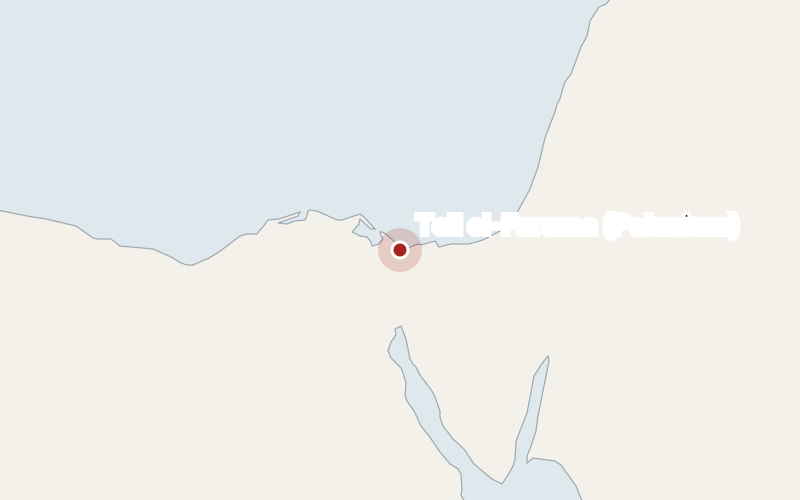
Greece & Rome · Roman period · Oxyrhynchus (El Bahnasa), Minya Governorate, Egypt
Roman-era mummies with gold tongues and Iliad papyrus found in Egypt
At Oxyrhynchus in Minya, a Spanish-Egyptian team also found jars of cremated human remains buried with cat bones, a rare practice in the area at that time.

Official announcement
Oxyrhynchus (El Bahnasa), Egypt A Spanish-Egyptian team has found Roman-period burials at Oxyrhynchus in Egypt. The site is the modern El Bahnasa, in Minya Governorate. Some of the mummies there were accompanied by metal tongues: three made of gold and one of copper. Inside one mummy was a papyrus with lines from the second book of Homer's Iliad.
Egypt's Ministry of Tourism and Antiquities announced the finds in April 2026.
The mission comes from the University of Barcelona and the Institute of the Ancient Near East. Maite Mascort and Esther Pons Mellado direct it. Hassan Amer, professor of archaeology at Cairo University, directs the excavation for the Egyptian side.
The results come from a preliminary report that the directors presented to the minister, Sherif Fathy. No scientific paper has yet been published.
Robbers left gold tongues behind in Tomb 65
The mummies came from Tomb 65, a hypogeum, or underground burial chamber. Some of the bodies were wrapped in linen bandages decorated with geometric patterns. They lay with painted wooden coffins. Amer said the coffins were badly deteriorated because the tomb was looted in antiquity.
La Brújula Verde reported his remarks. According to its account, the robbers broke open the coffins and took most of the valuables from the bodies. They left behind the metal tongues and the gold leaf stuck to the mummy wrappings.
Metal tongues are known from other burials of the Greek and Roman periods in Egypt. They were amulets meant to let the dead speak in the afterlife. The reports of the announcement connect them with the judgement of the dead before Osiris.
The reports differ on where the tongues lay. Archaeology News and Arkeonews say they were placed in the mouths of the deceased. La Brújula Verde describes them as deposited next to the bodies.
Traces of gold leaf were also found on some of the mummies. La Brújula Verde reads this as a sign that the people buried there were wealthy.
Hisham El-Leithy, Secretary General of the Supreme Council of Antiquities, described the papyrus found inside one of the mummies as rare. Its text comes from the passage of Iliad Book 2 known as the Catalogue of Ships. This passage lists the Greek contingents that sailed against Troy.
El-Leithy said the find adds an important literary and historical dimension to the site. La Brújula Verde says the text was extracted from the mummy's wrappings. The reports do not say how large the fragment is.
Oxyrhynchus has yielded huge numbers of papyri since the late 19th century. They include literary works, official documents and everyday records. Most of them came from the city's ancient rubbish heaps, not from burials. That is why a Homeric text inside a mummy has drawn attention.
La Brújula Verde reports that study of the papyrus may help show how far local elites had adopted Greek culture. It may also show how literary texts circulated in a provincial setting under Roman rule.
Cremation jars found beside a Ptolemaic tomb
A second area of work lay immediately east of Tomb 67. This Ptolemaic tomb was found and documented in the 2024 season. There the team opened a trench with three chambers built of limestone blocks. Only limited fragments of the chambers survive.
Mohamed Abdel-Badie, head of the Egyptian Antiquities Sector at the Supreme Council of Antiquities, described the contents. He said the first chamber held a stone slab and a large jar. The jar contained the cremated remains of an adult, the bones of an infant and the head of a cat, all wrapped in pieces of cloth. The second chamber held a similar jar with the cremated remains of two people and bones from the same animal family.
Cremation is uncommon in the Egyptian archaeological record. La Brújula Verde describes this sequence, burning followed by burial in a jar, as very rare in the area for the period.
Arkeonews reports that the chamber complex dates to the Roman period. The cemetery therefore holds both mummies and cremations from Roman times.
South of the excavated sector the team also recovered small terracotta and bronze figures. They include the god Harpocrates shown as a horseman and a small figure of Cupid. La Brújula Verde says the figures support the Roman date. It adds that they show Greco-Egyptian cults persisted in the region.
The recovered material will now go through conservation, laboratory analysis and photogrammetric recording. After that it will be moved to storage facilities of the Supreme Council of Antiquities. The Homeric papyrus is to receive a separate papyrological study.
Sources
- Roman cemetery in Egypt reveals golden tongues, mummies, and rare Iliad papyrus (Archaeology News)
- Mummies Buried with Golden Tongues and a Strange Papyrus with the “Catalog of Ships” from the Iliad Discovered in Oxyrhynchus (La Brújula Verde)
- Archaeologists Find Iliad “Catalog of Ships” Papyrus Inside Egyptian Mummy (Arkeonews)
- Roman-era burials discovered in Bahnasa (Archaeology Wiki)
Spotted a mistake? Tell the editor about a spelling error or a fact that is wrong. We correct stories openly.
Readers' picks show on the front page.
Follow @AncientHeraldHQ on X for the day's finds as they come in.

Comments
House rules. Stay on the subject, be kind to other readers and say where your facts come from. No advertising and no personal attacks. The editor reads along and hides comments that break these rules.
Loading comments…