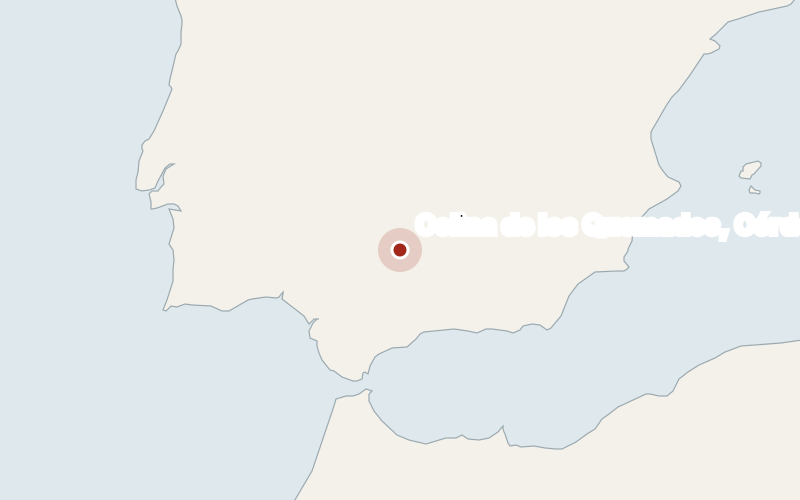
Greece & Rome · 2nd century AD · Berlanga de Duero, Soria, Castile and León, Spain
Enamelled Roman cup naming Hadrian's Wall forts found in central Spain
Found by a farmer near Berlanga de Duero, the 2nd-century bronze cup is the first of its rare type to list forts on the Wall's eastern sector.

Peer-reviewed paper
Berlanga de Duero, Spain A small enamelled bronze cup found in farmland near Berlanga de Duero, in the Spanish province of Soria, was made in northern Roman Britain. It dates from the 2nd century AD. The cup carries the names of four forts on the eastern stretch of Hadrian's Wall.
No other vessel of its kind names forts from that part of the frontier. The researchers think a local man who had served on the Wall brought it home. He was possibly a soldier of an auxiliary unit recruited in Celtiberia.
The study is published in the journal Britannia. Its authors are Roberto De Pablo Martínez, Susana De Luis Mariño, Jesús García Sánchez, Ignacio Montero Ruiz and Pablo Aparicio Resco. The team included researchers from the CAETRA Institute, the National Archaeological Museum in Madrid and Spain's research council, the CSIC.
The Berlanga Cup belongs to a small group of vessels known as Hadrian's Wall pans or fort cups. The first, the Rudge Cup, was found in 1725 at Rudge Coppice near Froxfield in England.
Others include the Amiens Patera from France, the Bath Pan and the Ilam Cup, also called the Staffordshire Moorlands Patera. There are also the Basildon fragment and the Hildburgh fragment, which was found in the León area of Spain.
All carry a schematic picture of the Wall with crenellated towers, and the names of some of its forts. Until now, every named fort lay in the central or western sectors.
Four forts named in their order along the Wall
The farmer found the cup in four fragments that fit together. Between 80 and 90 per cent of the vessel survives. It is hemispherical, with walls barely a millimetre thick and no handle or foot.
3D Stoa made a 3D reconstruction that corrected the distortion. It gives a diameter of about 11.4 cm and a height of around 8 cm. That makes the cup, with the Hildburgh fragment, the largest of the series. It is more than 3 cm wider than the Rudge Cup.
An inscription of 24 capital letters runs below the rim. The letters were incised after casting and filled with green and red glass paste. They read CILURNUM, ONNO, VINDOBALA and CONDERCOM.
These are the forts at modern Chesters, Halton Chesters, Rudchester and Benwell. They appear in their real order along the Wall. Four turquoise symbols shaped like a D or a crescent follow the names.
The team measured the surviving 286 mm of a circumference of about 358 mm. From this they calculated that only six or seven letters or symbols are lost. That is enough to complete two of the names, but not enough to fit a fifth fort.
The decoration uses red, green, turquoise and navy blue enamel. The enamel is set into cells cut in the bronze.
To find where the metal came from, the team used lead isotope analysis, carried out at Durham University. Lead from different ore deposits has a distinct mix of isotopes. So the signature in an object can be compared with known mines.
The alloy is a leaded bronze with about 3 per cent zinc. The comparison pointed to mines in the Pennines, Durham or north Wales. The team also analysed the enamels with a portable X-ray fluorescence spectrometer. They matched other objects made in Britain in the same period.
A soldier who may have served at the named forts
The authors suggest the owner may have served in the Cohors I Celtiberorum. This was an auxiliary unit raised in Celtiberia, the region that today covers much of Soria.
A military diploma found at Chesters, one of the forts on the cup, lists eleven cohorts including this one. The diploma is dated AD 145 to 146. Other units of Hispanic origin, the Ala I Asturum and Ala II Asturum Hispanorum, were stationed at Chesters and Benwell.
The researchers argue that a cup bought by any visitor would have carried a generic inscription, not the names of specific forts. The fort names, they say, were unknown outside Britain.
They propose two explanations. The cup may have been a gift recognising service on the Wall, perhaps at the end of a career. Or the soldier bought it before he went home.
In this sense, we agree with the term 'souvenir' or 'memento'; however, we do not believe these were souvenirs that merely commemorated a visit to the structure, but that behind this 'memento' there was a lived experience by its carrier or owner.
Roberto De Pablo Martínez and co-authors, in Britannia
Made to order, and dated by its forts
The find also weakens the idea that the pans formed a set covering the Wall section by section. The cup omits Pons Aelius (Newcastle) and Segedunum (Wallsend) further east, so it completes no section. Its incised letters also differ from examples with cast lettering.
The authors think each cup was made to order, with the buyer choosing the names.
They date the cup to between AD 124 and the late 2nd century. Benwell was built between AD 124 and 130. Pons Aelius, founded in AD 160, is absent.
Radar finds a building at the findspot
The team then surveyed the findspot, a plot called La Cerrada de Arroyo. It lies about 100 metres from the centre of Berlanga de Duero. They used 250-megahertz ground-penetrating radar and a systematic surface collection on a six-metre grid.
The radar showed a rectangular building of about 17 by 14 metres, with rooms on both sides. One of the rooms has preserved floors. To the south of the building is a room ending in an apse.
Surface finds included roof tiles, glass, slag, terra sigillata and painted pottery of local tradition. They date from the 2nd to the 4th century AD.
The team concludes the site was a permanent settlement, possibly a rural villa. It was in use from the 1st to the 4th century. The researchers say future work should help show whether it connects with Roman remains in the town centre.
Sources
- Rare 2,000-Year-Old Hadrian’s Wall Cup Discovered in Spain — One of Only Five Known (Arkeonews)
- A Roman Bronze Cup Found in central Spain was Made in Northern Britannia and Names the Forts of Hadrian’s Wall (La Brújula Verde)
- The Berlanga Cup (Archaeology Wiki)
- Roman cup found in Spain reveals new link to Hadrian’s Wall and Roman soldiers (Archaeology News)
Paper: De Pablo Martínez R, De Luis Mariño S, García Sánchez J, Montero Ruiz I, Aparicio Resco P. The Berlanga Cup. New Evidence of Hadrian's Wall Pans Found in Hispania Citerior (Spain). Britannia, 2026, 1-28. doi:10.1017/S0068113X26100701
Spotted a mistake? Tell the editor about a spelling error or a fact that is wrong. We correct stories openly.
Readers' picks show on the front page.
Follow @AncientHeraldHQ on X for the day's finds as they come in.


Comments
House rules. Stay on the subject, be kind to other readers and say where your facts come from. No advertising and no personal attacks. The editor reads along and hides comments that break these rules.
Loading comments…