Byzantium · 7th–15th century AD · Deep Mani, Peloponnese, Greece
DNA study finds Deep Mani Greeks largely escaped Byzantine-era Slavic migrations
Over half of men in the remote Peloponnese region descend from one man who lived around the 7th century AD, which researchers read as a sign of a severe population collapse.
Peer-reviewed paper
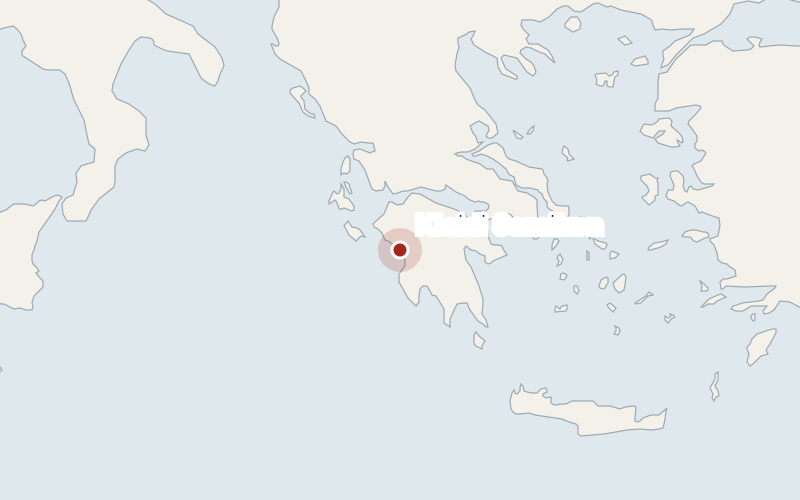
Deep Mani, Greece A genetic study of people from Deep Mani, at the southern tip of the Peloponnese in Greece, has traced most of their paternal lines to the region's ancient past. These lines go back to Greek-speaking populations who lived there in the Bronze Age, Iron Age and Roman period. The community remained largely untouched by the Slavic migrations that changed much of mainland Greece and the Balkans between the 6th and 8th centuries AD.
More than half of Deep Maniot men today descend from one man. He lived around the 7th century AD.
The study is published in Communications Biology. The University of Oxford led the work with Tel Aviv University and the National and Kapodistrian University of Athens. The other partners were the Areopoli Health Center, the European University of Cyprus and the genetic testing company FamilyTreeDNA.
The lead author is Dr Leonidas-Romanos Davranoglou. He is an associate researcher at Oxford, Tel Aviv and Athens.
The team studied living volunteers whose families come from Deep Mani villages. Arkeonews puts the total at 102 people. The researchers looked at two kinds of DNA that each follow a single line of descent. The Y chromosome passes from father to son, and mitochondrial DNA passes from mother to child.
Sampling had to cover different clans, because many villages are traditionally home to one extended family. Co-author Dr Anargyros Mariolis helped organise the work. He is director of the Areopoli Health Center and a native of the region. He drew on trust built over years of medical practice.
FamilyTreeDNA compared the results with a database of more than one million modern people and thousands of ancient DNA samples. It found almost no close matches with other populations.
The Maniots of Deep Mani preserve a snapshot of the genetic landscape of southern Greece prior to the demographic upheavals of the Early Middle Ages.
Dr Leonidas-Romanos Davranoglou, lead author, University of Oxford
One male line dominates after a 7th-century bottleneck
Over 80 per cent of Deep Maniot male lineages belong to one branch, haplogroup J-M172, according to Arkeonews. This branch appears only at low frequencies elsewhere in mainland Greece. Several of its sub-branches match populations living in Greece in the Bronze and Iron Ages.
The team reads the concentration of descent from a single 7th-century man as a sign of a severe bottleneck. In this reading, the population shrank to a few families. La Brújula Verde reports the likely causes as plague, armed conflict and the instability that followed the collapse of Roman power in the region.
Arkeonews notes that written records about Deep Mani almost disappear for several centuries in this period.
The geographic spread of the dominant paternal lineages closely follows the distribution of the region's fortified stone tower houses and its megalithic religious buildings. The researchers take this match as support for direct descent from the communities of Late Antiquity that built and lived in these places.
The team also dated the founders of the clans. Many present-day family lineages took shape in the late medieval period. La Brújula Verde puts this between the 14th and 15th centuries. Arkeonews puts it between the 14th and 16th centuries.
Some traditions claim descent from Byzantine nobles, Crusaders or imperial officials. Arkeonews reports that the genetic results suggest many of these stories express identity rather than biological origin. Traditions of shared ancestry between families, on the other hand, are borne out by the data, according to co-author Athanasios Kofinakos.
Many oral traditions of shared ancestry, some hundreds of years old, are now verified through genetics.
Athanasios Kofinakos, co-author and adviser on the genealogy and history of Mani
Maternal lines came from further afield
The maternal side is far more varied. The team identified at least thirty mitochondrial lineages. They have connections to the eastern Mediterranean, the Caucasus, western Europe and North Africa.
The researchers read this as the mark of a strongly patriarchal society. In this picture, men stayed on the family land, and a small number of women from other communities married in.
Our study is the first to recover the untold stories of Maniot women, whose origins were largely obscured by male-centered oral traditions.
Prof. Alexandros Heraclides, European University of Cyprus
The results fit a Byzantine account. In the 10th century the emperor Constantine VII Porphyrogenitus wrote about the Maniots. He said they were "not of the lineage of the Slavs, but of the Romans of old who were called Hellenes". He also recorded that they went on worshipping the Olympian gods into the 9th century, long after the rest of the empire had become Christian.
The study used DNA from living people. Arkeonews reports that future work on ancient DNA from archaeological remains in Mani may help clarify one open question. That question is whether the Maniots descend directly from the region's ancient inhabitants, or from refugees who sheltered there in times of crisis.
Prof. Theodoros Mariolis-Sapsakos of the University of Athens said the team plans to work with the community again. The aim is to explore whether further genetic analyses of the population could be relevant for clinical and public health research.
Sources
- A genetic study reveals the millennial isolation of the Maniots, the Greeks who continued worshiping the Olympic gods until the 9th century (La Brújula Verde)
- They Worshipped the Olympian Gods Until the 9th Century — DNA Reveals the Hidden Descendants of Ancient Hellenes (Arkeonews)
Paper: Davranoglou, L.-R., Kofinakos, A.P., Mariolis, A.D. et al. Uniparental analysis of Deep Maniot Greeks reveals genetic continuity from the pre-Medieval era. Communications Biology 9, 157 (2026). https://doi.org/10.1038/s42003-026-09597-9
Spotted a mistake? Tell the editor about a spelling error or a fact that is wrong. We correct stories openly.
Readers' picks show on the front page.
Follow @AncientHeraldHQ on X for the day's finds as they come in.


Comments
House rules. Stay on the subject, be kind to other readers and say where your facts come from. No advertising and no personal attacks. The editor reads along and hides comments that break these rules.
Loading comments…