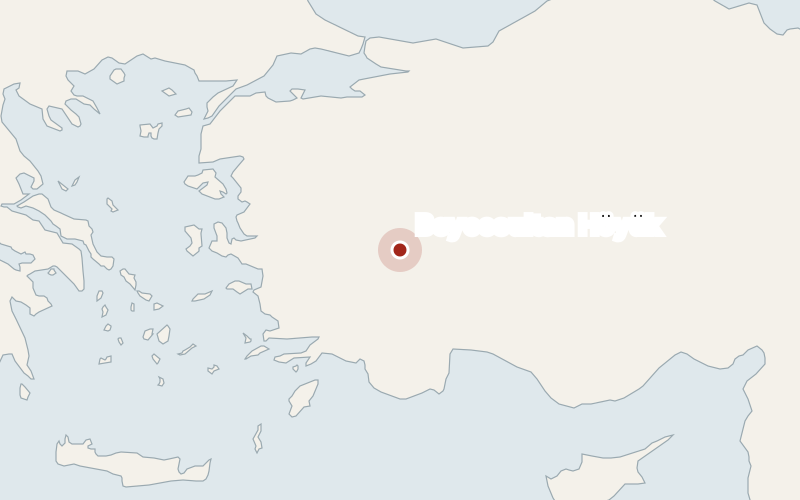
Bronze Age · c. 1259 BC · Hattusa (Boğazkale), Çorum province, Turkey
Fragment of Kadesh peace treaty between Hittites and Egypt found at Hattusa in Turkey
The clay piece, part of an Akkadian copy of the pact between Ramesses II and Hattusili III, preserves clauses on people fleeing between the two kingdoms.

Official announcement
Hattusa (Boğazkale), Turkey A fragment of a clay tablet from Hattusa, the Hittite capital in central Turkey, belongs to an Akkadian copy of the Kadesh peace treaty. It was found in the city's royal citadel. The Hittite king Hattusili III and the Egyptian pharaoh Ramesses II concluded the treaty around 1259 BC. The surviving lines come from its clauses on people who fled from one kingdom to the other.
Turkey's Minister of Culture and Tourism, Mehmet Nuri Ersoy, announced the identification on 21 September 2026. That date is the International Day of Peace. The ministry has not yet published a full transcription or translation of the fragment.
Specialists took a year to identify the fragment
The piece was found at Büyükkale, the fortified hill that held the palace of the Hittite kings. It lay near a structure excavators call Building E. The Istanbul branch of the German Archaeological Institute leads the excavations there.
Only one face of the fragment survives. La Brújula Verde describes it as not much bigger than a matchbox. According to the ministry, specialists studied the inscription for about a year. Only then could they say with certainty which document it came from.
That work placed the lines within Articles 12 to 20 of the treaty, the block of clauses on fugitives. The readable passages mention people fleeing from Egypt to Hatti, and from Hatti to Egypt. Hatti was the Hittites' name for their own kingdom. The passages also refer to the destruction of their homes.
Ersoy said the fragment includes a ban on destroying the homes of people who had fled. He presented it as a message that still matters today. In the same announcement, he expressed hope for a future in which all people, particularly Palestinians, could live in safety and peace.
The treaty did not grant asylum in the modern sense. It obliged each side to return the other's fugitives. Some clauses, however, forbade punishing or harming the people who were sent back and their families.
La Brújula Verde notes that the fragment adds nothing new to the known content of the treaty. Scholars have reconstructed that content in detail for more than a century. The fragment's value is as another physical piece of the clay copies kept in the Hittite royal archives. It helps to check and complete the versions already known.
Both kingdoms kept copies of the pact
The treaty followed a long contest between Egypt and the Hittites for influence in the eastern Mediterranean, especially in what is now Syria. Around 1274 BC, the armies of Ramesses II and the Hittite king Muwatalli II fought near Kadesh, on the Orontes River. The battle had no decisive result.
About 15 years later, Ramesses agreed terms with Muwatalli's successor, Hattusili III. The terms covered peace, mutual military assistance and the return of fugitives. The two kings never met in person. Messengers and intermediaries negotiated the agreement.
The original was inscribed on silver, which has not survived. What remains are the copies each court made. The Egyptians carved theirs in hieroglyphs on the walls of the Karnak temple and the Ramesseum at Thebes.
The Hittites recorded theirs on clay tablets in Akkadian, the shared diplomatic language of the Near East at the time. They filed the tablets in the palace archives at Büyükkale. According to La Brújula Verde, it is the only diplomatic agreement from the ancient Near East preserved in versions from both parties.
The German archaeologist Hugo Winckler found the first copies from Hattusa when he excavated the site in 1906. They lay among more than ten thousand cuneiform tablets. Arkeonews dates the early recoveries to excavations between 1906 and 1912.
Pieces of the treaty are now held in four museums. Two are in Turkey: the Istanbul Archaeological Museums and the Museum of Anatolian Civilizations in Ankara. The others are Berlin's Museum of the Ancient Near East and the State Hermitage Museum in St Petersburg.
Hattusa lies next to the village of Boğazkale in Çorum province. It became a UNESCO World Heritage Site in 1986. Its tablet archives were added to UNESCO's Memory of the World Register in 2001.
The excavation team plans to keep searching the palace ruins at Büyükkale for further fragments of the treaty's Akkadian copies.
Sources
Spotted a mistake? Tell the editor about a spelling error or a fact that is wrong. We correct stories openly.
Readers' picks show on the front page.
Follow @AncientHeraldHQ on X for the day's finds as they come in.


Comments
House rules. Stay on the subject, be kind to other readers and say where your facts come from. No advertising and no personal attacks. The editor reads along and hides comments that break these rules.
Loading comments…